
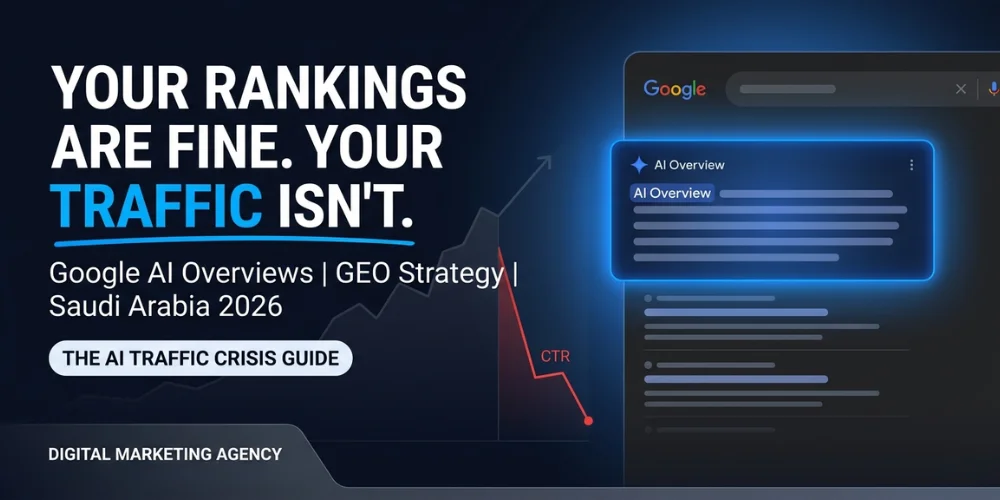
Your website ranks on page one. Your technical SEO is clean. Your backlinks are growing. And yet your traffic is quietly collapsing.
If this sounds familiar, you are not alone. Across Saudi Arabia, business owners and marketing managers are staring at the same confusing dashboard: stable rankings, shrinking clicks. The cause is not a Google penalty. It is not a competitor outranking you. It is something most local agencies are not telling you about and it is called the Google AI Overview traffic crisis.
In this guide, you will learn exactly what is happening, why Saudi businesses are uniquely exposed, and the precise framework to recover your visibility before your competitors do.

What Is a Google AI Overview and Why Should Saudi Businesses Care?
A Google AI Overview is the AI-generated summary block that now appears at the very top of Google search results, answering the user’s query before they ever see a single website link.
According to BrightEdge’s 12-month analysis, AI Overviews now trigger on 48% of all tracked search queries a 58% increase year over year. When one appears above your listing, organic click-through rates drop by 61%, according to Seer Interactive’s September 2025 research covering 3,119 informational queries across 42 organizations.
Here is the brutal reality for Saudi businesses: over 97% of Saudi Arabian consumers rely on search engines before making a purchase decision. If AI is now answering those searches before users reach your website, you are losing customers you never knew existed.
Is This Really Happening? The Data Saudi Business Owners Need to See
This is not a theory. The numbers are hard and accelerating.
HubSpot reported organic traffic declines of 70–80%. Forbes reported declines of approximately 50%. Business Insider saw organic search drop between 40–55%. These are not struggling publishers these are globally dominant content brands with enormous SEO budgets.
The overlap between top-10 Google rankings and AI Overview citations has collapsed from 75% in mid-2025 to between 17% and 38% by early 2026 meaning high rankings no longer guarantee AI visibility.
And the trend is accelerating. By late 2025, zero-click searches had grown toward 70% of all queries — meaning the majority of Google searches now end without a single website visit.
For Saudi businesses running on organic traffic for lead generation, this is an existential threat hiding in plain sight.
Why Saudi Businesses Are More Exposed Than They Realize
The Arabic + English Double Vulnerability
Saudi companies typically compete in both Arabic and English search. This creates a compounded risk: AI Overviews are expanding across both languages simultaneously, and most local SEO strategies were built for a pre-AI world.
SEO in 2026 is no longer about stuffing keywords or building random backlinks it is about understanding user intent, creating valuable content, and aligning with how AI-driven platforms like ChatGPT interpret and recommend content. Most agencies operating in the Saudi market have not made this shift.
The Vision 2030 Digital Surge Is Creating New Exposure
Digital ad spending in Saudi Arabia is expected to exceed SAR 10 billion in 2026, and AI will play a major role by personalizing content, enhancing SEO, and streamlining content production. As more Saudi businesses invest in digital, the competition for AI citation not just rankings is about to intensify dramatically.
Mobile-First Behavior Amplifies the Zero-Click Effect
Mobile search accounts for over 72% of all search queries in Saudi Arabia. On mobile screens, AI Overviews push organic results even further below the fold, making clicks rarer. If you are not in the AI Overview, you are invisible to most mobile users before they even scroll.
The Silent Traffic Killer: What Your Analytics Are Not Showing You
Here is the contrarian insight most Saudi marketers miss entirely:
Your Google Search Console data is lying to you by omission.
If your impressions are growing but your clicks are flat or declining, AI Overviews are harvesting your snippet without sending traffic. This is the impression-click divergence the clearest diagnostic signal that you have an AI Overview problem, not a rankings problem.
Websites with perfect technical SEO, strong backlinks, high-quality content, and stable rankings are still losing organic traffic because the search landscape itself has changed.
The fix is not to rank higher. Ranking higher means the AI Overview extracts more of your content. The real goal is to become the source the AI cites not the source the AI summarizes away.

The GEO Framework: How to Recover Your Traffic in 2026
GEO – Generative Engine Optimization is the new discipline replacing traditional SEO for content visibility. It is not a replacement for SEO; it is the layer on top that determines whether AI systems cite you or ignore you.
Here is the step-by-step recovery framework for Saudi businesses:
Step 1 — Diagnose Your AI Exposure
Open Google Search Console and run this test. Compare 12-month impressions versus 12-month clicks for your top 50 pages. If impressions are stable or rising while clicks are declining, you have confirmed AI Overview traffic loss. Flag all informational content “how to,” “what is,” “best way to” pages as high-risk assets.
Step 2 — Restructure Content with BLUF Architecture
BLUF stands for Bottom Line Up Front. Every page Google’s AI is likely to reference must lead with a direct, concise answer in the first two to three lines before any context, backstory, or narrative. AI systems are trained to extract the most direct answer. If your answer is buried in paragraph four, a competitor’s answer in paragraph one will be cited instead.
Step 3 — Add FAQ Schema to Every Key Page
FAQ schema markup signals to Google’s AI systems exactly which questions your content answers and in what format. Adding FAQ schema and original data points makes your content the citation source rather than the source AI summarizes away. Every service page, every blog post, every landing page targeting informational queries should carry FAQ schema.
Step 4 — Publish Original Data and Named Frameworks
The content structure that earns Google AI Overview citations answer-first format, schema markup, semantic entity coverage, original data is highly correlated with citation in other AI search platforms as well. Saudi businesses that conduct original market research, publish case studies, or develop named methodologies give AI systems content that cannot be paraphrased away. Original data must be cited.
Step 5 — Maintain a 90-Day Content Freshness Cycle
Pages not updated in 90+ days are 3x more likely to lose AI citations, with more than 70% of pages cited by AI updated within the last 12 months. Build a quarterly content refresh cycle into your editorial calendar. Updating existing high-performing pages consistently outperforms publishing new generic content.
Step 6 — Audit Your AI Crawler Accessibility
Check your robots.txt file for any blocks on GPTBot, PerplexityBot, ClaudeBot, or Google-Extended 34% of businesses are unknowingly blocking at least one major AI crawler. If AI systems cannot crawl your pages, they cannot cite you regardless of your content quality.

The Action Plan: 30-Day AI Visibility Sprint for Saudi Businesses
Week 1 — Diagnose: Run the Search Console impression-click divergence test. Identify your top 20 pages with AI citation risk.
Week 2 — Restructure: Rewrite the introductions of your top 10 service and blog pages using BLUF format. Add direct definitional answers to every H2 heading.
Week 3 — Schema: Implement FAQ schema on all restructured pages. Add Article schema with author E-E-A-T signals across your blog.
Week 4 — Measure: Run manual prompts for your core service keywords in ChatGPT, Gemini, and Perplexity. Track whether your brand appears. This is your new share-of-voice metric.

